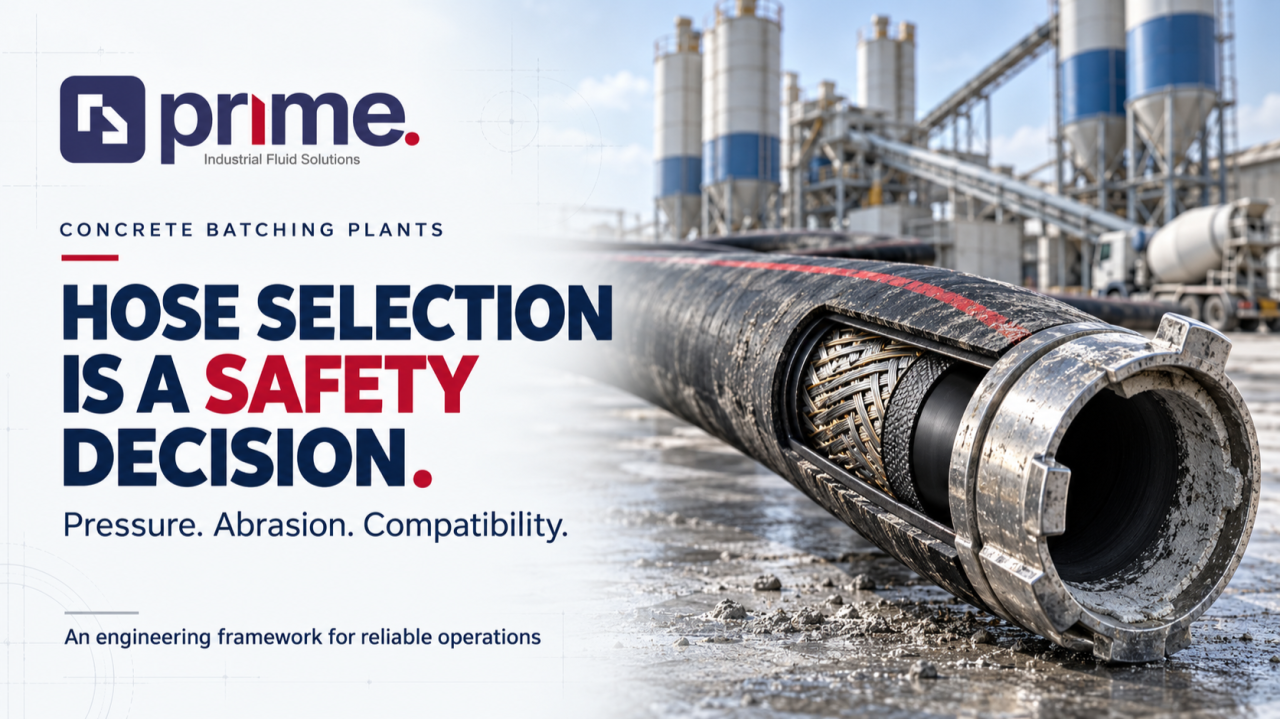
Most operators treat hoses as a line item. A replaceable part. Something you order when the old one wears out and forget about until the next failure. This mindset is costing concrete batching plants more than they realize — in downtime, in safety risk, and in money.
Correct hose selection is not a procurement afterthought. It is an operational decision that directly determines whether your plant runs continuously, whether your personnel stay safe, and whether your cost structure remains predictable.
The Reality of Hose Systems in a Concrete Batching Plant
A concrete batching plant is not a single-hose operation. It’s a network of distinct pressure zones, each with its own material, flow, and safety requirements. Treating them as interchangeable is where most selection errors begin.
Here are the core categories operators need to account for:
• High-pressure concrete pumping hoses — built to withstand the abrasive, high-pressure flow of wet concrete through the pumping line.
• Hydraulic hoses — responsible for transmitting power to the plant’s moving components; failure here affects machine function directly, not just material flow.
• Water hoses — used throughout the mixing process; lower pressure, but critical to batch consistency.
• Air hoses — support pneumatic systems and control functions; a failure can halt automated processes instantly.
• Abrasion-resistant hoses — specifically engineered for aggregate and cement transfer, where constant friction from particulate material degrades standard hose linings quickly.
Each of these serves a different point in the production chain. Each faces different stress, pressure, and wear conditions. Selecting a generic hose type across these applications — because it’s cheaper or more available — is where the risk starts.
What Happens When the Wrong Hose Is Selected
The consequences of incorrect hose selection are not hypothetical. They are operational realities reported across the industry:
1. Production stoppage. A hose failure at any point in the system can halt the entire production line. Concrete batching is a sequential process — a failure upstream stops everything downstream.
2. Delivery delays. Concrete has a limited workable window. A production halt doesn’t just cost you time on-site; it can cost you the batch itself and the client relationship attached to it.
3. Increased replacement costs. A hose mismatched to its application wears out faster. What looks like a cost-saving choice at purchase becomes a recurring expense through premature failure and frequent replacement cycles.
4. Safety hazards. High-pressure systems under failure conditions are dangerous. Personnel working near pumping lines or hydraulic systems face real risk when the wrong hose specification is in place.
None of these outcomes are consumable-level consequences. They are operational and safety consequences. That is the distinction that needs to shape how hose selection is approached.
Reframing the Decision: What Correct Selection Actually Requires
If hose selection is a strategic decision, it needs a structured process behind it — not a catalog lookup. At Prime-IFS, our approach to this follows four defined steps:
1. Site Analysis
Before any product is recommended, the specific conditions of the plant are assessed: pressure requirements, material types being transferred, environmental exposure, and the existing configuration of the system. No two plants operate under identical conditions, and no single hose specification serves all of them equally well.
2. Product Matching
Based on the site analysis, hose types are matched to each specific application point — pumping, hydraulic, water, air, and abrasive transfer — rather than applying a single product across multiple uses. This is where the categories outlined above are translated into actual specifications.
3. Technical Verification
Matched products are verified against the technical requirements of the application: pressure ratings, material compatibility, and durability standards. This step exists to confirm that what is recommended is what the plant actually needs — not what is simply available or convenient.
4. Post-Installation Support
Selection doesn’t end at delivery. Ongoing support after installation ensures that performance is monitored, issues are addressed early, and the system continues to perform as intended under real operating conditions.
This sequence exists for one reason: to remove guesswork from a decision that carries real operational and safety consequences.
A Question Worth Asking Your Own Operation
If a hose failed at your plant tomorrow, do you know which point in your system would be most affected — and what it would cost you in downtime?
If the answer isn’t immediately clear, that’s worth addressing before it becomes an incident rather than a question.
I’d like to hear how other operators and plant managers in this space are approaching hose selection and maintenance planning. What’s worked for your operation? What hasn’t?
If you’re reassessing your plant’s hose systems or want a structured site analysis for your specific setup, reach out to Prime-IFS directly. This is a conversation worth having before the next failure — not after it.
Related Articles

Hoses
Hotels are among the most demanding buildings to protect from fire. They combine sleeping occupants who may be unfamiliar with the layout, high concentrations of furnishings…